
What is wearing your knee down after 60
Two things are working on that knee, and most people only ever count one of them. The first is wear and tear, decades of load going through one joint. The second is sugar, and that is the one Dr. Martin says gets missed.
Dr. Martin on how a joint goes:
Dr. Martin, The Doctor Is In, Episode 713There's a way that your joints start to wear down.
He was answering a question about osteoarthritis, and notice that he does not treat it as age simply doing what age does. He describes a process with steps you can name. That is the whole reason he thought there was something to be done about it.
Weight is part of the picture and he is matter of fact about it. More weight is more pressure through a hip and a knee, and he told people carrying it that the joint would wear out sooner. He is equally clear that it happens to people who were never heavy, from old injuries, so pressure is one factor rather than the whole answer.
The second factor is the one you can still do something about at 65.
Bone on bone, in plain words
It is the phrase people come home from an appointment carrying, and it sounds like a verdict. It is closer to a description.
Between the bone ends there is cushioning. Over years that cushioning thins, and when enough of it has gone the two surfaces are working against each other with very little padding left. Less cushioning, less movement. That is the sequence he lays out, and bone on bone is simply the far end of it.
He also makes a point about the pain itself. The body limits how much you move a joint that is in trouble, and the stiffness is part of that. Protective in the short run. The problem is that a knee you stop using loses the muscle around it, which is the support the joint needed. The wider version of that argument is in what causes joint pain after 60.
Glycation, sugar in the joint
This is his answer to why two people the same age, the same weight, with the same history of standing on concrete, end up with knees in completely different condition.
Dr. Martin on what ages a joint:
Dr. Martin, The Doctor Is In, Episode 713I talk about that oxidative damage, one of the ways your body ages in the joint, is what we call end products like caramelization, AGE it's glycation.
Caramelization is the word he reaches for because everyone has watched it happen in a pan. Sugar, heat and time, and what was liquid turns brown, hard and sticky. He is saying that a slow version of the same chemistry runs inside you, sugar sticking to the proteins in tissue, and the joint is one of the places it shows.
AGE is his shorthand for the end products of it, advanced glycation end products.
Dr. Martin on what glycation takes:
Dr. Martin, The Doctor Is In, Episode 713Glycation just takes away the lubrication in your joints and your muscles.
Lubrication is close to the entire job of a joint. A knee that is well lubricated moves through its range quietly and the surfaces glide. Take that away and every step is a little more friction, a little more grinding, a little more of the wear you were trying to avoid. That is his picture of how sugar ends up in a conversation about knees.
And read the second half of that sentence again, because he says joints and your muscles. Same process, same loss, in the tissue that was supposed to be holding the joint together. It is the link between this section and the next one.
What drives glycation is sugar, and he says so without hedging. This is the same argument he makes about the liver, written up in what a month of sugar does to your liver, and about uric acid in red meat and gout. One input, several places it lands.
"Muscles will help to anchor your joints."
Dr. Martin, The Doctor Is In, Episode 713Why strong muscles take the load
When he is asked what to do about a knee, the first thing out of his mouth is not a supplement.
Dr. Martin on taking the pressure off:
Dr. Martin, The Doctor Is In, Episode 713One of the things that'll take away pressure from your joints, guys, is when you have strong muscles.
Think about what actually holds a knee together. Not the bone. The muscle and connective tissue around it, the quadriceps above and the calf below. When those are strong they carry a share of every step. When they have wasted, the joint takes the load on its own.
That is why he says muscles anchor the joint. It is also why the years after 60 matter so much, because muscle goes quietly at that age unless something is asking for it. Nobody notices losing it. Everybody notices the stairs.
Which sets up the trap plainly. A sore knee makes you move less, moving less costs you muscle, and less muscle puts more load back through the sore knee. He is trying to break that circle at the muscle end, not the pain end.
Move, move, move
Move, move, move, and get strong. He said it so often it became a sort of refrain, and in this episode it sits directly after the glycation explanation rather than as a throwaway.
He is not describing a gym programme, and there are no numbers on this page because he gave none here. What he pushed was ordinary daily loading. Walking. Getting out of a chair without using your hands. Carrying the groceries in. Stairs while you still have them.
The second half of it, get strong, is the part that gets dropped. Movement alone keeps a joint mobile. Strength is what builds back the anchor. For a woman past 60 that is the difference between a knee that is merely still moving and a knee that has support underneath it.
If a knee is badly worn, what you can do with it is a conversation for you and your own practitioner. Nothing here is a diagnosis, and nothing here is a reason to change something you have been told to do about your joints.
What he kept on the shelf
Sugar down, muscle up. That is the order, and everything else is support while you do it.
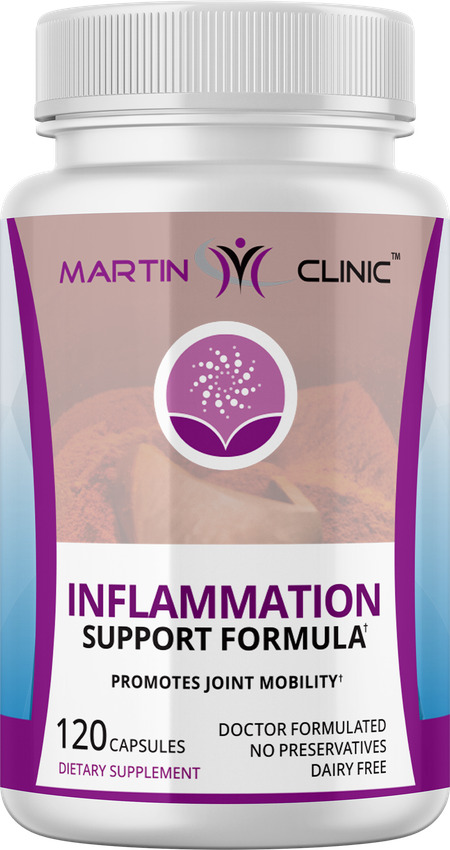
In the same answer he names what the clinic kept on the shelf for this exact question, the Inflammation Formula. He also says, separately in that episode, that he loves DHA for the joints, which is why the fish oil sits in the same conversation.
Neither of those is a replacement for the first two. He was blunt about that ordering every time it came up, and this episode is no exception. The formula is for the inflammation end of the problem while the sugar and the muscle end get sorted out.
For the wider joint picture there is what causes joint pain after 60, and the rest of what he thinks is collected on the index.
Nothing here is a reason to start or stop anything a doctor has prescribed. Talk to your doctor first.
Common questions
What causes knee pain after 60?
He names two things. Wear and tear from decades of load through the joint, and glycation, the sugar damage that ages the joint from the inside.
Does sugar cause knee pain?
He says sugar causes glycation, and that glycation takes away the lubrication in your joints and your muscles. That is the link he draws.
What does bone on bone mean?
It describes a joint that has worn down until there is little cushioning left between the bone ends, so there is less movement in it.
Do strong muscles help knee pain?
That is his first answer. He says strong muscles take pressure off the joint, and that muscles help to anchor your joints.
What did he give patients for their joints?
In this episode he names the Inflammation Formula. Separately he says he loves DHA for joints.
Read next: Inflammation In Women Over 60: Dr. Martin On Curcumin and What Causes Joint Pain After 60?.
What he reached for
Martin Clinic's Inflammation Formula is the one he names in this episode when the question is a worn joint. It is the one he points at for the inflammation end of the problem, with a 60-day money-back guarantee.
60-day money-back guarantee.These statements have not been evaluated by the Food and Drug Administration. This product is not intended to diagnose, treat, cure, or prevent any disease. Always consult your healthcare practitioner before starting a new supplement, especially if you are pregnant, nursing, taking medication, or have a medical condition.