
Do you need a cortisol test after 60
A woman asked him on air how you know if someone has high cortisol. This was the answer.
Dr. Martin on testing:
Dr. Martin, The Doctor Is In, Episode 1578Well, the best way to know really is to, I like the old urine test for cortisol, but guys, you don't need a test because someone was on yesterday or maybe the day before.
He said it twice, which is usually a sign he means it.
Dr. Martin, The Doctor Is In, Episode 1578But you don't need a cortisol test necessarily.
Read that carefully, because it is not what people assume he is saying. He is not telling you to skip the test. Answering the comment that asked for one, he said straight out that he is not against it. He tested in the office himself, and he says plainly that he was not guessing in there. His point is that the test is not what decides it.
What cortisol is and where it comes from
Before the testing question, he goes back a step, because the answer depends on knowing what the hormone is for.
Dr. Martin on cortisol:
Dr. Martin, The Doctor Is In, Episode 1578Cortisol comes out of your adrenals, your adrenal secrete cortisol, normal, but you don't always want that to be turned on.
Two small glands sitting on top of your kidneys. Cortisol coming out of them is normal, and he is emphatic that it is supposed to. It gets you up in the morning, it brings your blood pressure up, it puts you in gear. What he does not want is the switch stuck on.
"I used to tell people, and I've been observing people with high cortisol for a long period of time, stress, the stress hormone."
Dr. Martin, The Doctor Is In, Episode 1578That is his standard, and notice it is not a number. It is a question about how much of the day the hormone is working. A lab value cannot answer that on its own.
The tests that exist
There are three routes, and they catch different things.
- Urine. The one he names as the test he liked. It collects over a stretch rather than at a single moment.
- Blood. One draw, at one time of day, usually in the morning when cortisol is meant to be at its peak.
- Saliva. Usually taken several times across a day, so it is aimed at the shape rather than the level.
What he is reading, whichever route, is whether the hormone is winding down when it should be. He puts it plainly elsewhere in the same episode: it wakes you up in the morning, but you better be trending downward at night.
Why one blood draw can read normal
This is the practical reason a woman over 60 can feel wired, sleep badly, and still be told her cortisol is fine.
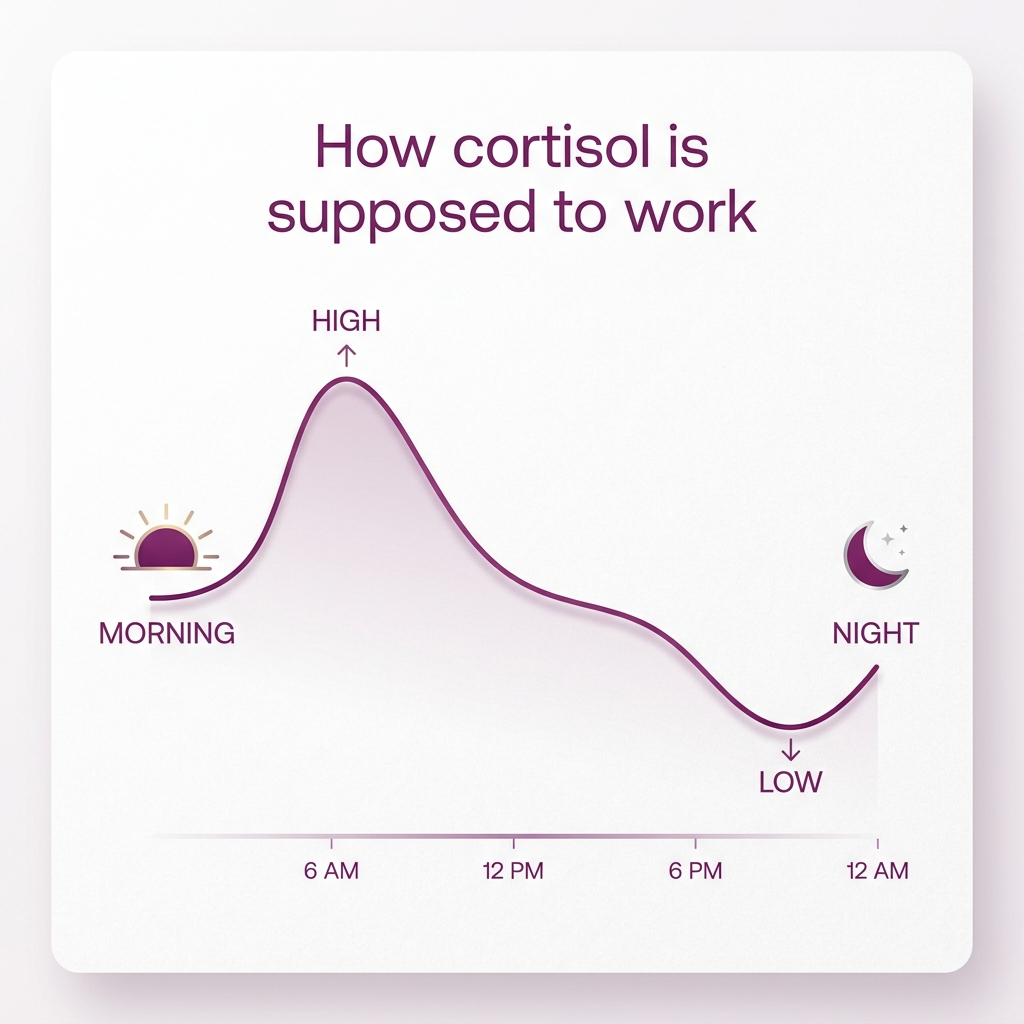
Cortisol is not a level, it is a curve. It is meant to be high in the morning and almost gone by bedtime. A single draw catches one point on that curve. Taken in the morning, a high reading is exactly what should be there, so it reads normal. The thing that is actually wrong, that it is still high at nine at night, is not in the sample at all.
If the daily pattern is the part you want, we went through it in when is cortisol highest.
What he looked at instead
His alternative is not a hunch. It is a method he ran for decades in a clinic.
Dr. Martin on where his read comes from:
Dr. Martin, The Doctor Is In, Episode 1578I used to tell people, and I've been observing people with high cortisol for a long period of time, stress, the stress hormone.
He describes getting close enough to be intimidating and admits as much. He was looking for clues. Hair. Skin. Eyes. He would ask people to stick their tongue out so he could look at it. He looked at eyebrows. General observations, he calls them, made across thousands of people.
And there was a questionnaire. You could not see him unless you filled it out, no exceptions. He would have the answers in front of him before he ever ordered anything.
The one he describes from the inside is the feel of it. Cortisol, he says, is like a vibration. If you know that hum, the racing head and the pulse that will not settle at the wrong end of the day, that is the thing he was reading off a face.
Symptoms trump testing
That phrase is his, and he applies it to hormones generally, not only to cortisol. What have I always said when it comes to hormones, he asks, and then answers himself: symptoms trump testing.
He guards it immediately. He is not saying do not test. He tested. He is saying the symptoms come first and the number confirms or complicates them, rather than the other way round.
Applied to yourself after 60, that means the questions worth answering are the ones he would have put on the sheet. Are you wired at night and flat in the morning. Is there weight around the middle that will not shift. Do you wake at two or three with a busy head. Is your recovery worse than it used to be, from an infection or a bad week. None of that is a diagnosis, and plenty of it has other causes worth ruling out. It is the picture he would want before anyone quoted a value at him.
He applies the same rule to the thyroid, which is why the thyroid never acts on its own reads like a companion piece to this one.
What he does about it
Same order as always. Food first, because insulin and cortisol pull on each other. Then the clock: a bedtime that does not move, light in the morning, and a genuine wind-down instead of lying there still vibrating.
Then the things that keep the switch on without being called stress. He names the ones he saw doing the damage in his own patients, and caring for a parent is high on the list. Relationships, family, money, and the environmental load nobody counts. Caffeine sits in there too, which is where what he says about coffee, caffeine and a leaky gut comes in.
Nothing here is a reason to change a prescription or skip a test your own practitioner has asked for. It is his order of operations, and the order starts with what you can already see.
Common questions
What is a normal cortisol level for a woman over 60?
He does not quote a range. His position is that the number matters less than the pattern through the day and the symptoms that go with it.
How do you test for high cortisol?
He says he liked the old urine test for cortisol. Blood and saliva are the other routes, and saliva is the one usually taken several times in a day.
Do I need a cortisol test?
On his answer, not necessarily. He is not against having one done. He is against treating the result as the thing that decides it.
Why does my cortisol test come back normal?
Because the level is supposed to move through the day. One draw is a snapshot, so a reading taken at the right hour can look fine even when the shape of the day is wrong.
What happens if cortisol stays high?
He says cortisol is meant to have a part-time job, not a full-time one, and that the trouble starts when it never switches off, because your body stays in a state it was only built to hold briefly.
Read next: What Causes High Cortisol In Women Over 60 and High Cortisol Symptoms In Women Over 60: The Checklist.
Work on the adrenals
Martin Clinic's Cortisol Control Formula was built for the adrenals, for the situation he describes here, where cortisol has taken on a full-time job instead of a part-time one.
60-day money-back guarantee.These statements have not been evaluated by the Food and Drug Administration. This product is not intended to diagnose, treat, cure, or prevent any disease. Always consult your healthcare practitioner before starting a new supplement, especially if you are pregnant, nursing, taking medication, or have a medical condition.