When cortisol is highest in the day
The short answer is the morning, and he does not hedge it.
Dr. Martin on the peak:
Dr. Martin, The Doctor Is In, Episode 1039Cortisol is highest in the morning, of course.
The word of course is doing some work there. To him this is not a problem to be solved, it is the design. The reason he gives is the one most women have never been told.
Dr. Martin on what cortisol actually is:
Dr. Martin, The Doctor Is In, Episode 1039Cortisol isn't only a stress hormone, it works with the circadian rhythm.
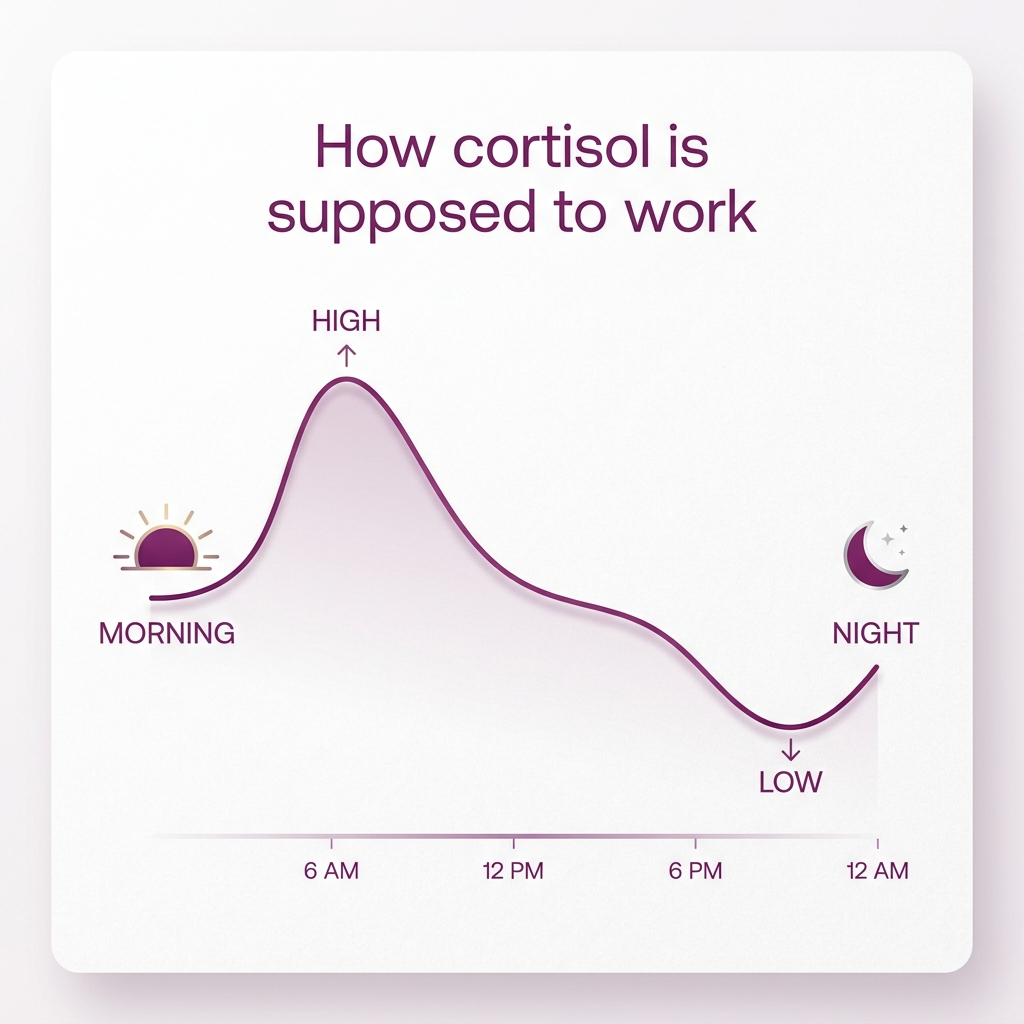
Your body runs on a cycle, he says, like clockwork. Cortisol is part of that clock. It rises to get you up and out of bed, and it is meant to spend the rest of the day coming down.
The curve, in plain words
Picture a line rather than a level. It climbs in the last hour or two before you wake, peaks not long after your feet hit the floor, then falls steadily all day. After supper it keeps sinking. By bedtime there should be almost nothing left of it.
That shape is the whole story. A number on its own tells you very little, because the same reading can be exactly right at seven in the morning and completely wrong at ten at night. What he is reading is the trend through the day.
"Cortisol is on your side until it's not."
Dr. Martin, The Doctor Is In, Episode 1039That line is the hinge of the episode. He is not against cortisol. He calls it a good guy. What he is against is cortisol staying switched on.
Why the curve flips after 60
Cortisol is not meant to be high for a long stretch. That is his phrasing, and the long stretch is exactly what a lot of women over 60 have had. Years of it, not weeks.
Dr. Martin on the pattern he wants:
Dr. Martin, The Doctor Is In, Episode 1039Cortisol should be higher in the morning, not at night.
When the demand never lets up, the curve loses its shape. Instead of a clean climb and a long fall you get something flatter, and often something reversed, where the lowest point of the day lands in the morning and the highest point lands in the evening. Nothing about the hormone has changed. The timing has.
He is blunt about what that does to a night of sleep. He puts the figure at 70 per cent of the population not getting a good night, and he does not treat that as a sleep problem first. He treats it as a cortisol problem.
Dr. Martin on what is behind it:
Dr. Martin, The Doctor Is In, Episode 1039So the biggest factor in sleep is cortisol.
Primary, he says, not the only cause. That distinction is his, and it is worth keeping. Plenty of other things break a night. This is the one he goes to first.
Wide awake at night, flat in the morning
Here is what the flipped curve feels like from the inside, and why it gets described as everything except a hormone.
- Tired all evening, then wide awake the moment your head hits the pillow
- Asleep easily enough, then awake at two or three in the morning with a busy head
- A full night on the clock that leaves you no better in the morning
- Dragging until the middle of the day, then finally feeling like yourself at night
What connects them is not how long you were in bed. It is how deep you got, and that is the part cortisol interferes with.
Dr. Martin on sleep quality:
Dr. Martin, The Doctor Is In, Episode 1039And cortisol doesn't allow that deep sleep.
Deep sleep and REM are where the repair happens. A night that never gets there is a night you wake up from unrepaired, which is why he says when you are not sleeping it is almost impossible to lose weight. Cortisol elevates insulin, and the two of them do not work in your favour overnight.
What he calls the vibration
Most explanations of cortisol are numbers. His is a feeling, and it is the most recognisable thing in the episode.
He describes it as a vibration in the body. Have you ever been worried and you cannot stop worrying, he asks. Your brain is racing. Your heart rate is up a little. Your pulse is up a bit. And underneath it there is a hum you cannot switch off. That, he says, is what cortisol does to you.
Some people feel it plainly and some do not sense it at all. If you do recognise it, he is describing it at the wrong end of the day, when the curve should have been falling for hours.
Why a morning blood sugar reading looks high
This is his side note in the episode, and it answers a question a lot of women ask with a glucose meter in their hand.
Patients would tell him their morning blood sugar was the one they could not get down. His answer was that your body is waking up, and cortisol is what wakes it. That is the dawn effect. It is not a sign the meter is broken and it is not, on its own, a sign that everything you did yesterday failed.
He is describing a mechanism, not reading your results. Nothing here is a reason to change anything you have been prescribed. If a morning number worries you, that is a conversation with whoever manages it.
Getting the curve back
His first instruction is not a supplement. It is the same one he opens most episodes with.
Start in the kitchen, he says. Cortisol elevates insulin, so food that spikes insulin all day is pushing on the same lever from the other end. Getting the carbs and sugars under control is step one, and it is free.
Then there is the discipline part, which he is direct about. Your body works on a cycle like clockwork, and he says many people are not disciplined in this area and it really makes a difference. Same bedtime. Same wake time. Light in the morning. Winding down on the inside before you expect the lights to go out, rather than lying down still vibrating.
He also talks about this from the gut end, because caffeine sits in the middle of it. If that is your question, what he says about coffee, caffeine and a leaky gut is the other half of the argument. And the whole of it connects back to the gland everyone blames on its own, which is why the thyroid never acts on its own.
If you want the longer version of what he does about a curve that will not come down, we wrote that up separately in how to lower cortisol after 60.
Common questions
What time of day is cortisol highest?
In the morning. He says that is the point of it, because cortisol is what wakes you up.
Should cortisol be low at night?
Yes. On his description it should be sinking after supper, so that by the time you are sleeping your cortisol is sleeping too.
Is cortisol only a stress hormone?
No. He says it works with the circadian rhythm as well, and that treating it as a stress hormone only is where people get confused.
Why is my blood sugar higher in the morning?
He puts the dawn effect down to cortisol waking the body up. His answer to patients was that your body is waking up and cortisol is doing the waking.
Does cortisol stop deep sleep?
He says cortisol does not allow that deep sleep, which is why a night that looks long on the clock can still leave you flat.
Read next: Cortisol Levels In Women Over 60: Do You Need The Test? and What Causes High Cortisol In Women Over 60.
Get the curve back
Martin Clinic's Cortisol Control Formula was built for the adrenals, and the job it is aimed at is the one he describes here: cortisol trending down at night instead of staying up.
60-day money-back guarantee.These statements have not been evaluated by the Food and Drug Administration. This product is not intended to diagnose, treat, cure, or prevent any disease. Always consult your healthcare practitioner before starting a new supplement, especially if you are pregnant, nursing, taking medication, or have a medical condition.